07. Statistics(ANOVA)

07. Statistics(ANOVA)
[toc]
석회황이 벌에게 미치는 효과 분산분석 보고서
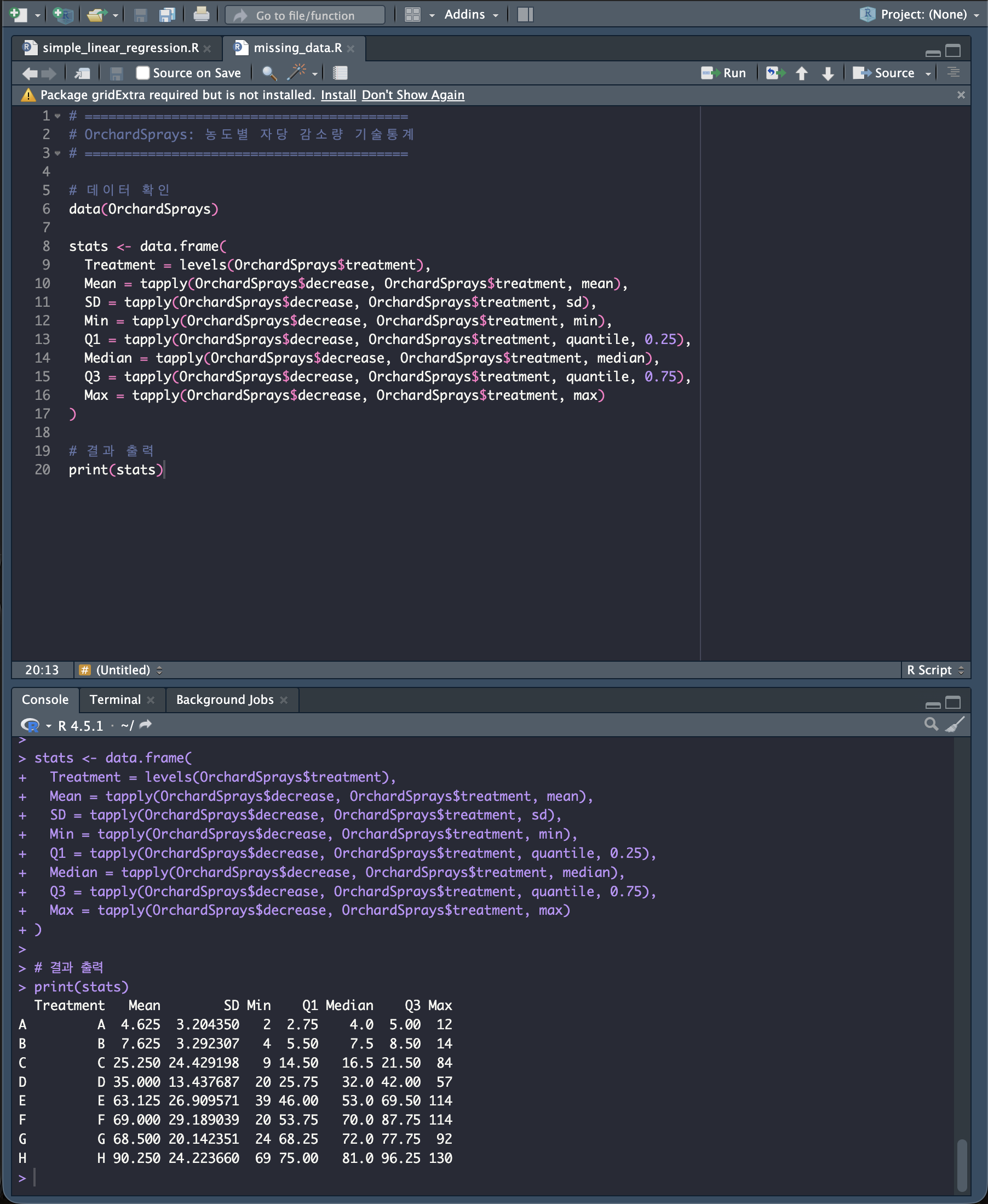
R의 OrchardSprays는 8가지 농도(A > B > ... > H)의 석회황유화액(lime surphur emulsion)을 자당 용액(sucrose solution)에 섞은 후, 농도별로 8개의 벌 방에 발랐다. 여기에 100마리 벌을 넣은 후 2시간 뒤, 각 벌 방에서 줄어든 자당 용액의 양을 측정하였다. 그림 1은 농도별 자당 감소량의 상자도표(boxplot)이며, 표 1은 각 농도별 자당 감소량의 평균과 표준편차 등을 요약한 기술통계 표이다. 또한 일원분산분석(ANOVA)을 이용하여 석회황 농도에 따라 자당 감소량이 유의미하게 달라지는지를 확인하고, 사후 분석으로 던컨의 다중비교법(여기서는 Tukey HSD 대체)을 사용하여 농도 간 차이를 비교하였다. 유의수준은 0.05로 설정하였다. 농도별 자당 감소량 boxplot
# 데이터 확인 data(OrchardSprays) # Boxplot boxplot(decrease ~ treatment, data = OrchardSprays, main = "Boxplot of Sucrose Decrease by Concentration", xlab = "Treatment (A > B > ... > H)", ylab = "Decrease in Sucrose Solution", col = "lightblue", border = "black") # 평균값 표시 means <- tapply(OrchardSprays$decrease, OrchardSprays$treatment, mean) points(1:length(means), means, col = "red", pch = 19) # 평균값 텍스트 표시 text(1:length(means), means, labels = round(means, 2), pos = 3, col = "red") 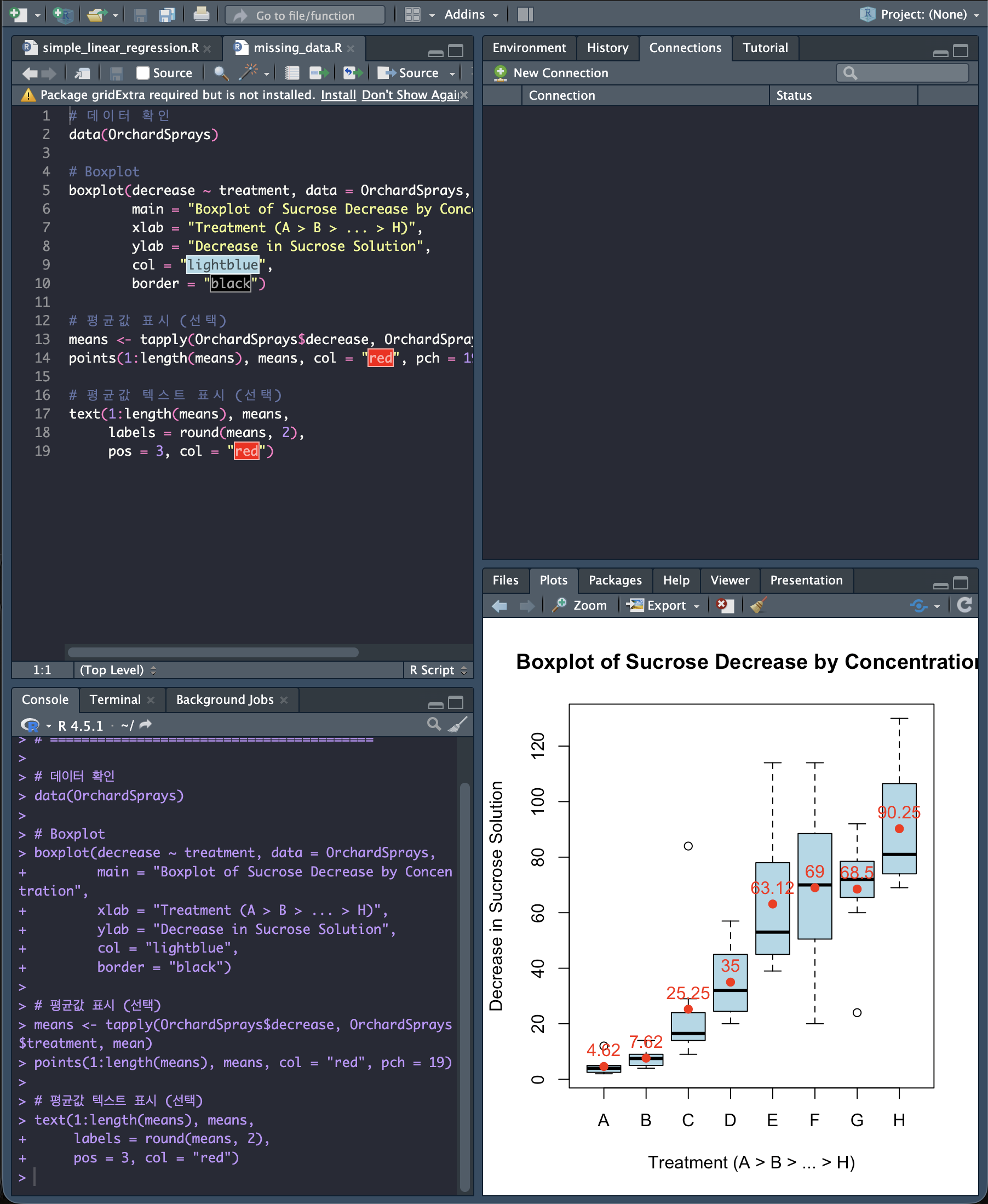
석회황 농도별 자당 감소액의 기술통계
# 데이터 확인 data(OrchardSprays) stats <- data.frame( Treatment = levels(OrchardSprays$treatment), Mean = tapply(OrchardSprays$decrease, OrchardSprays$treatment, mean), SD = tapply(OrchardSprays$decrease, OrchardSprays$treatment, sd), Min = tapply(OrchardSprays$decrease, OrchardSprays$treatment, min), Q1 = tapply(OrchardSprays$decrease, OrchardSprays$treatment, quantile, 0.25), Median = tapply(OrchardSprays$decrease, OrchardSprays$treatment, median), Q3 = tapply(OrchardSprays$decrease, OrchardSprays$treatment, quantile, 0.75), Max = tapply(OrchardSprays$decrease, OrchardSprays$treatment, max) ) # 결과 출력 print(stats) | 농도 | 평균 | 표준편차 | 반복수 | 최소 | 최대 |
|---|---|---|---|---|---|
| A | 4.625 | 3.204 | 8 | 2 | 12 |
| B | 7.625 | 3.292 | 8 | 4 | 14 |
| C | 25.250 | 24.429 | 8 | 9 | 84 |
| D | 35.000 | 13.438 | 8 | 20 | 57 |
| E | 63.125 | 26.910 | 8 | 39 | 114 |
| F | 69.000 | 29.189 | 8 | 20 | 114 |
| G | 68.500 | 20.142 | 8 | 24 | 92 |
| H | 90.250 | 24.224 | 8 | 69 | 130 |
일원분산분석 결과 (ANOVA Table)
# ========================================= # OrchardSprays: 일원분산분석 (ANOVA Table) # ========================================= # 데이터 불러오기 data(OrchardSprays) # 일원분산분석 모형 적합 fit <- aov(decrease ~ treatment, data = OrchardSprays) # ANOVA Table 출력 anova(fit) # 또는 (동일 결과) summary(fit) 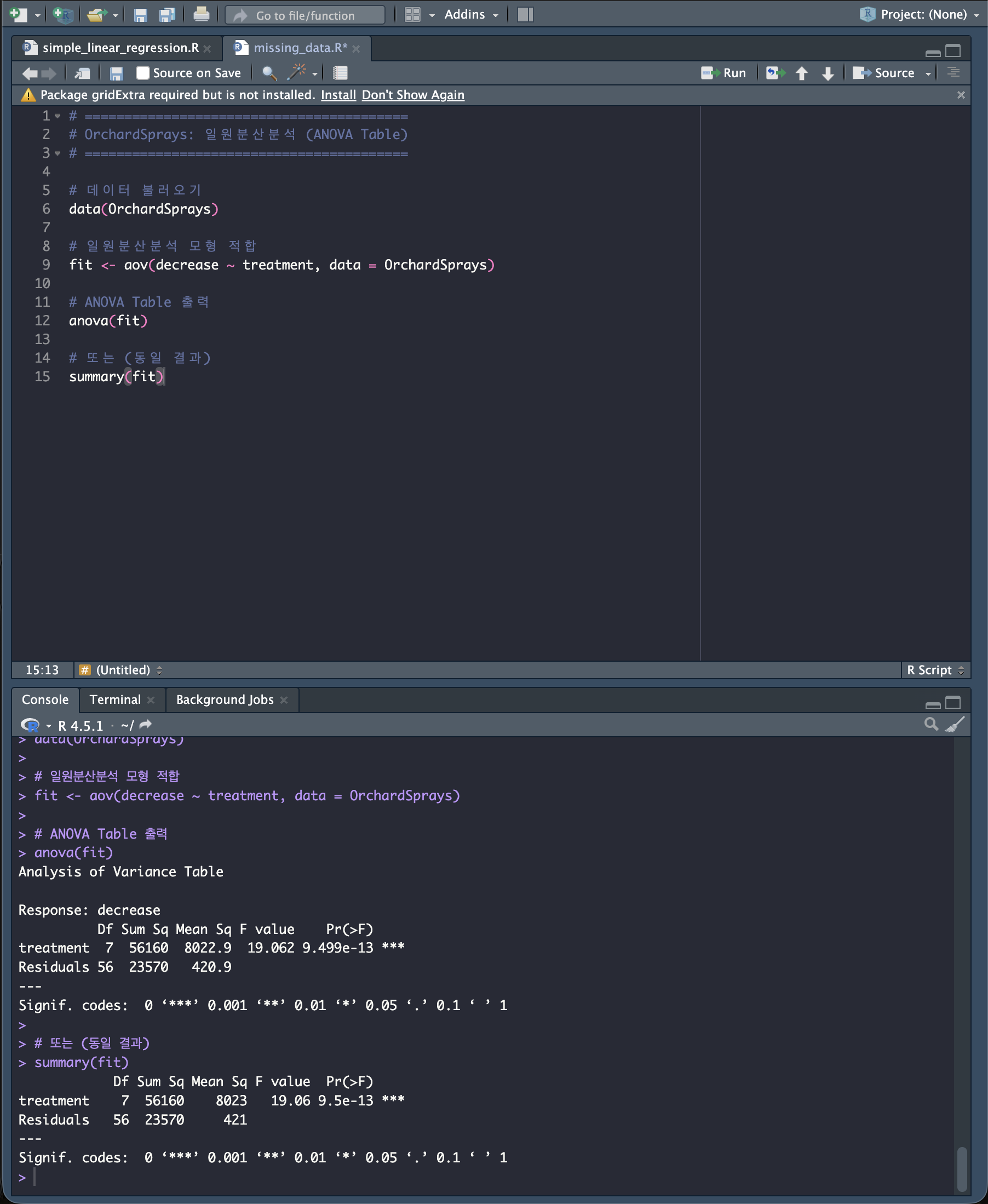
- 유의확률 p = 9.499e-13 이므로, 농도에 따른 자당 감소 효과는 동일하지 않다 (통계적으로 유의미한 차이가 존재).
던컨 다중비교 (Tukey HSD 결과)
# ========================================= # 그림 3: 던컨 다중비교 (Tukey HSD 대체) # ========================================= # 데이터 불러오기 data(OrchardSprays) fit <- aov(decrease ~ treatment, data = OrchardSprays) tukey_result <- TukeyHSD(fit) # 그래프 plot(tukey_result) 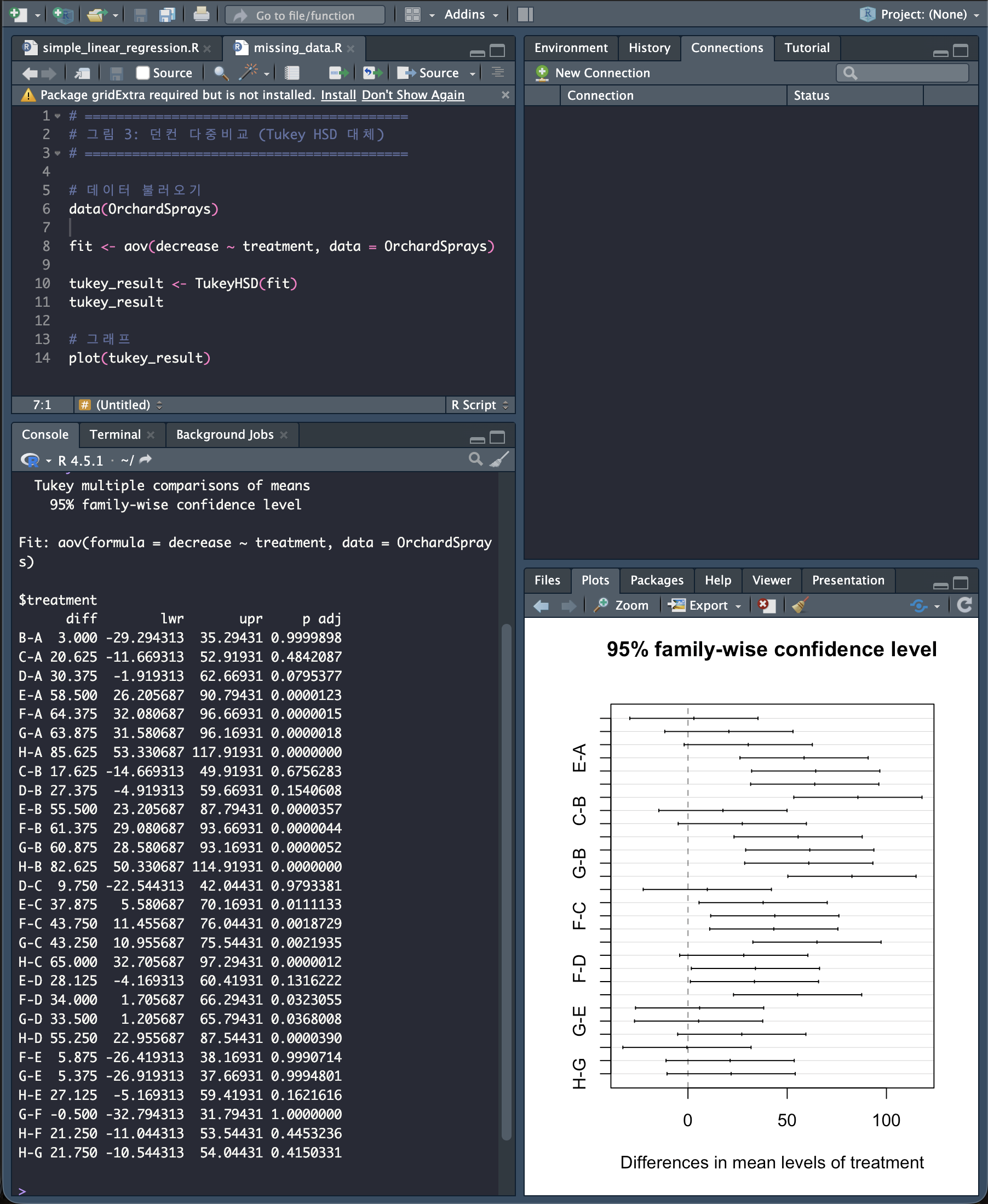
- Tukey HSD 결과에 따르면:
- 농도 F, G, E는 동일 그룹으로 묶인다.
- 농도 A, B는 동일 그룹이며 가장 감소량이 작다.
- 농도 H는 유의하게 가장 높은 감소량을 보인다.
부록
Boxplot 코드
boxplot(decrease ~ treatment, data = OrchardSprays) ANOVA 수행 코드
fit <- lm(decrease ~ treatment, data = OrchardSprays) anova(fit) ANOVA 콘솔 출력
Analysis of Variance Table Response: decrease Df Sum Sq Mean Sq F value Pr(>F) treatment 7 56160 8022.9 19.062 9.499e-13 *** Residuals 56 23570 420.9 --- Signif. codes: 0 ‘***’ 0.001 ‘**’ 0.01 ‘*’ 0.05 ‘.’ 0.1 ‘ ’ 1 Duncan 다중비교 (Tukey HSD 대체) 코드
install.packages("agricolae") library(agricolae) duncan.test(fit, "treatment", alpha = 0.05, console = TRUE) Duncan 다중비교 콘솔 출력 요약((Tukey HSD 결과)
decrease groups H 90.250 a F 69.000 b G 68.500 b E 63.125 b D 35.000 c C 25.250 cd B 7.625 d A 4.625 d End.